StudyForge is embarking on a multi-year plan to expand our course offerings in the United States beyond just mathematics. Our team is hard at work creating new courses that meet state standards, bringing our industry-leading pedagogy and course design to new subject areas. As we have begun this process, we have come to realize something.
Ya’ll (we were recently in Georgia) in the US have a whole lot of standards.
My heart goes out to all of you American educators. Trying to meet all of those standards must feel like needing to do triple backflips through razor-wire hoops.
My colleague and friend, Richard Bitgood, wrote an article called “The Most Failed Course in America: An Outsider’s Perspective.” In it, he makes a compelling case that Algebra 1 is a broken course that is too big and too hard for most students to succeed.
I have observed this trend in other subject areas as well, though, including my own areas of expertise, social studies and English. As an example, I am the lead curriculum writer for a new World History course we are developing. In Canada, world history is taught over a four-year period from 7th to 10th grade. StudyForge’s plan is to refine, combine, and supplement that content to create one World History course for the US market. At first, I thought the majority of the standards would already be covered, as our Canadian social studies courses are rigorous and cover the entirety of human history. Imagine my surprise when I found out that Texas alone has 104 standards for World History; Florida has about 120, and a lot of them do not overlap with Texas’s. The UCLA national standards are excellent, but there are about 450 of them, and they are intended to be covered in three different years. How could students gain even a moderate understanding of that many topics in a single year?
The short answer: They can’t, and I think most teachers instinctively know this.
So what can we do about this? As teachers and curriculum developers, I think it is critical to approach this problem in a pragmatic, practical, student-centred way, conscious of how people actually learn.
Four Guiding Principles
Here are a few guiding principles that I think can help us make good pedagogical choices:
- Principle 1: If You Try to Do too Much, You Won’t Do Anything Well
This is true of teaching and of life: If your attention is spread too thin, you will not be able to give your best to anything. If you want to be an effective teacher, you cannot give equal attention to every topic. Use your expertise and professional judgment to select the most important topics in your subject area and dive deep into those, and cover the other standards with less rigor.
Here are some questions to ask when you are trying to decide where to devote most of your attention:
- Is this something that every well-educated person should know?
- Is this something that is pre-requisite knowledge for something I know students will have to cover in a future year?
- Is this something that is likely to be on an important standardized test?
- Is learning this topic in depth going to improve students’ overall quality of life or improve their future educational prospects?
- If they do not know much about this, will they still be able to get along in life?
In his article about Algebra 1, Richard Bitgood says that when we teach students less and teach more difficult concepts later, there is a positive outcome:
We can teach it better. To be more specific, we can spend more time on the deeply important concepts, the truly foundational ideas. We can give students and teachers space to breathe.
Students learn better when they have time to process and digest topics, so rushing from one thing to the next to make sure everything is covered is actually a disservice to them. Spend most of your time on the things that matter most.
- Principle 2: Build Frameworks of Understanding, Not Libraries of Trivia
I am not an expert in cognitive psychology, but I know that I understand new information better when I have a framework to hang new information on. In subject areas that I have expertise in, I can learn new things more easily because I have a foundational understanding that I can build from.
The psychological term for this is a schema. Julia Stern defines a schema like this:
Schema is a mental structure to help us understand how things work. It has to do with how we organize knowledge. As we take in new information, we connect it to other things we know, believe, or have experienced. And those connections form a sort of structure in the brain.
For example, when thinking about world history, memorizing specific dates for specific events is less important than having a schema of the big-picture narrative of history. Dates are important, but they are important because it is essential to know the cause-and-effect relationship between events.
The Great Depression in Germany in the 1920s
↓
was worse because of the Treaty of Versailles in 1919
↓
which was signed after Germany lost World War 1 in 1918.
The dates establish chronology and cause-and-effect. This is why our world history courses for the Canadian market have a timeline across the top of every lesson, showing students where what they are learning fits into the broad scope of history.
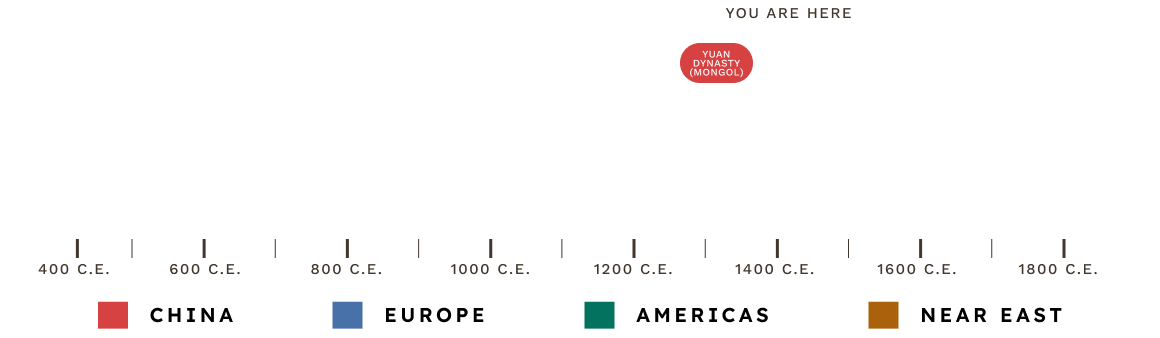
The human mind needs to have information categorized, so helping students develop schemas will serve them both now and in their future learning. Then, when you need to spend a few minutes teaching a particularly arcane state standard, hopefully students already have a framework that they can hang that new information on.
No upside-down tightrope walking required.
- Principle 3: Focus on Developing Transferable Skills
Every subject area has essential skills that are required for academic success. As you are designing your curriculum or instruction, think about these skills and give students an opportunity to build them. For example, every English student needs to know how to construct a paragraph with a topic sentence, supporting details, and a concluding sentence; every social studies student needs to be able to distinguish between primary and secondary sources; every science student needs to know how to create a hypothesis and use the scientific method.
If you have a course that has way too many standards, it is still critical to ensure students are developing these foundational skills. Design your instruction around forming these transferable skills rather than just having students memorize and regurgitate facts.
- Principle 4: Accelerate Coverage of Some Standards by Connecting with Prior Knowledge
If you have 100+ standards to cover in a single course, there are some things that will need to be covered much more quickly than others. Not everything can receive the same attention or go into the same level of depth. Nor should it. But the standard still needs to be covered, so how can you quickly cover those standards that you have determined need less attention?
A key thing to remember about human learning is that we learn best when we are connecting new information to prior knowledge. Making those connections to prior knowledge makes the acquisition and retention of new knowledge much easier.
To use another example from world history, the Byzantine Empire is a gap in many students’ understanding of history. While it is an important topic for historians, perhaps you, as a subject expert, have decided that this is not where you want to spend most of your attention. Students probably have already heard of the Roman Empire, so you can begin there.
INFORMATION
CONNECTION TO PRIOR KNOWLEDGE
The Roman Empire grew to cover a huge area of territory
Show the size of the territory on the map and compare it to the size of the United States
In those days, it was hard to hold a big empire like that together because they didn’t have the fast ways of communicating that we have today
Connecting to their understanding of the importance of communication technology
Eventually, the empire split into the Western and Eastern Empires
Connect this to the US Civil War, highlighting both similarities and differences
The Western Empire fell, but the Eastern Empire continued until 1453 CE, and another name for the Eastern Roman Empire is the Byzantine Empire
Connect to students’ understanding of the Fall of Rome, presumably covered earlier in the course.
Making these connections can accelerate a student’s understanding of a complex topic, allowing it to be covered more quickly.
Long-Term Change and Improvement is Possible
In reality, though, all of these suggestions involve making the best of a less-than-ideal situation. A better approach would be to do the long-term, difficult work of affecting policy decisions at the state or provincial level, improving standards so that teachers do not need to do cartwheels while juggling flaming bowling pins in order to do what is best for their students.
Change is possible.
For example, in 2024, Oregon adopted new standards in social studies, and having examined them briefly, I am thoroughly impressed. There are only 19 standards in the World History course, a much more manageable number. Each standard is sufficiently broad that it could be met in a number of different ways, and each comes with a variety of sample topics that teachers could use to meet those standards, but if the teacher has another idea, they are free to do that instead. It leaves the instructional choices in the right hands — those of teachers and curriculum developers who know their students and their contexts better than anyone else.
Although you are doubtless an incredible educational acrobat, wouldn’t it be better if you did not need to be?
About the Author