


A common maxim around our school is that “children do well if they can.” This philosophy from Ross Greene suggests that if a student can’t, it is our job to figure out why so we can help.
When a colleague first introduced us to this philosophy, she shared the example of a math student she’d supported through learning services. They’d tried all kinds of resources, various strategies, and new programs, but nothing seemed to be the right fit, and most efforts ended in eruptions of anger. After working side-by-side with him over the years, they eventually uncovered a very unusual unsolved problem: his shirt! Once it came off, he could grapple with those math problems like a pro wrestler!
This story served as an uplifting reminder to stay curious and persevere when supporting struggling students. However, the challenge of finding the right solution for each unique student also felt incredibly daunting at times.
When I recently transitioned roles from online English teacher to learning support coach, I was excited to devote more time to expanding my understanding of how students learn and how to best support their learning. I wanted to delve into everything so that I could better support teachers with the daunting task of helping each individual student to do well. I absorbed as much information as I could on a wide range of topics – from literacy skill development to neurodivergent support strategies to assessment for learning.
As I dug into these seemingly unrelated topics, an unexpected commonality began to emerge. Beneath the varying strategies presented, a strong relationship with students was repeatedly emphasized as the essential foundation – key to cultivating the necessary conditions for growth and revealing what each individual student needs to flourish.
Before any methodologies or resources can be useful for learning, a student must feel safe to engage with them. Think of a student struggling with reading acquisition — the most evidence-based literacy strategy in the world won’t take root if that student doesn’t feel safe enough to make mistakes in front of you.
Dr. Chris Mattatall, Associate Professor of Educational Psychology at the University of Lethbridge, uses a framework of four pillars built upon the foundation of “community and relationship building: social/emotional/trust” to illustrate the importance of this sense of safety to the learning process.
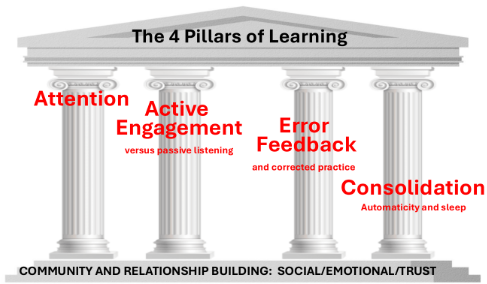
Mattatall, Chris. “The 4 Pillars of Learning.” RenewEd 2025, Kelowna BC.
He explains that in order for students to engage in learning and be willing to take the risks necessary to grow, we’ve got to be able to get things past the reticular activating system. He shares this explanation from cognitive psychologist, Judy Willis, to break down how the RAS determines which information is allowed in:
- During stress or fear, the RAS filter gives intake preference to input considered relevant to the perceived threat, at the expense of the sensory input regarding the lesson.
- Unless the perception of threat is reduced, the brain persists in doing its primary job — protecting the individual from harm.
- During fear, sadness, or anger, neural activity is evident in the lower brain, and the reflective, cognitive brain (prefrontal cortex) does not receive the sensory input of important items, such as the content of the day’s lesson.
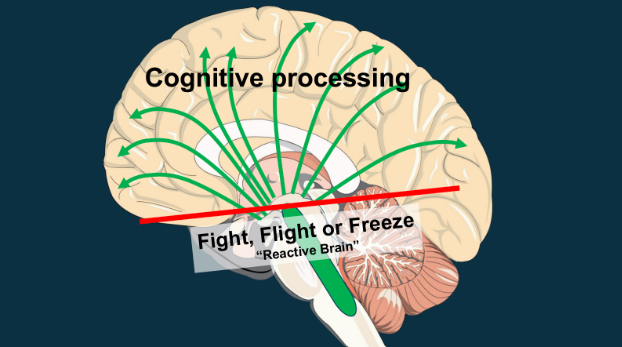
Mattatall, Chris. “The 4 Pillars of Learning.” RenewEd 2025, Kelowna BC.
Strong relationships and healthy community establish the supportive environment needed for the brain to feel safe enough to learn.
In ADHD 2.0, Dr. Edward Hallowell, M.D. asserts that fear is the “major learning disability” and also identifies supportive relationships as the tool for overcoming it. He stresses the vital necessity of human connection to our health and learning by referring to it as “Vitamin Connect,” equating its importance to that of Vitamin C in our lives.
He goes on to share the story of his wise first grade teacher, Mrs. Eldridge, as an illustration of the power of connection in the classroom setting. In contrast to the common practice of skipping students who struggled to read aloud, Mrs. Eldridge would sit beside little Ned when it was his turn and put her arm around him as he stammered his way through the passage. “None of the kids would laugh at me… Mrs. Eldridge’s arm was my treatment plan. She gave me psychosocial integration.”
In addition to shielding Ned from shame, Mrs. Eldridge’s presence seems to have also helped him to find what Dr. Hallowell refers to as “the Goldilocks sweet spot” between challenge and capability where learning can really take root. This zone of proximal development is different for each unique individual; knowing our students’ interests and strengths is crucial to helping each of them to find their “right difficult.” Once again, relationship is the key. Dr. Hallowell’s advice for parents provides valuable guidance for teachers as well:
“Look for that special something and help your child feel good about who s/he is. Identify his/her talents, strengths, interests and dreams. Teach him/her to see and believe in what s/he can do, and avoid the tendency to focus on what s/he can’t do. When you believe in your child, it makes it easier for him/her to believe, too.”
One of the highlights of my year was attending the Canadian Assessment Conference in Vancouver, BC this past spring. Having just read ADHD 2.0, I found myself reflecting on how fear is so often associated with assessment. If fear is actually the greatest obstruction to our students’ learning, how much do our current assessment practices contribute to this? How much more would students flourish if our assessment practices cultivated a sense of clarity, confidence, and agency instead?
The opening keynote speaker, Natalie Vardabasso, proposed a change in posture that directly addressed these questions. She encouraged us to reflect back on the Latin origin of the word ‘assessment’ as a guide for moving forward. The word is ‘assidere’: which means ‘to sit beside.’ What if we adjusted our posture from that of a judge presiding over the court of learning to the supportive stance of a partner in the student’s learning journey?
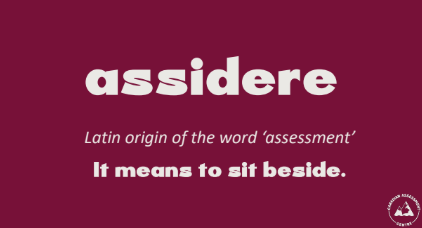
Vardabasso, Natalie. “Future of Assessment.” Canadian Assessment Conference, Canadian Assessment Centre, April 2026, Vancouver, BC.
Just like Mrs. Eldridge’s arm gave little Ned Hallowell the courage to persevere as he read aloud, a collaborative approach to assessment provides students the safety to reflect honestly as they learn. This is facilitated by a shift in focus from assessment of the product to the assessment of the process. Our role changes from handing down a final verdict to guiding them as they tell the story of their own learning.
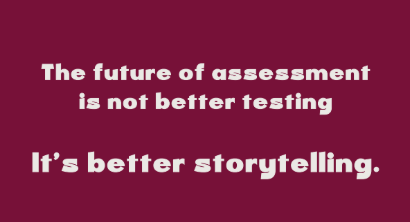
Vardabasso, Natalie. “Future of Assessment.” Canadian Assessment Conference, Canadian Assessment Centre, April 2026, Vancouver, BC.
But how do we “sit beside” students who live and work miles away from us? How do we deliver that essential dose of “Vitamin Connect” through an online platform?
When I first traded my physical classroom for a virtual one years ago, I assumed it meant sacrificing the relational aspect of teaching. However, I soon discovered it was the opposite: The online context turned out to be much more conducive to building constructive relationships with my students. Instead of managing a chaotic classroom full of students from up front, the majority of my interactions with students were reflective, personalized, one-to-one discussions about their learning. The initial process of connecting with students and building that relationship does, however, require a bit more creativity and initiative within the online context.
Here are some tips for relationship-building shared by teachers within our online school:
- Invite new students, and supporting adults, for an introductory video chat; ask about their strengths, interests, goals, and how you can best support them.
- Offer weekly office hours along with virtual tutorials, study sessions, and community gatherings throughout the year.
- Use automated emails to welcome students, check in on low activity, and celebrate milestones; keep the tone warm and supportive. Approach these as prompts for further conversation.
- Communicate expectations, procedures, and deadlines clearly in advance, building in checkpoints to confirm student understanding.
- Create opportunities for dialogue around the learning process, including outlines, drafts, revisions, and self-reflection.
- Embed personalized videos on your homepage to welcome students, model tricky processes, preview rubrics, evaluate sample assignments, and share tips.
- Share personal stories, photos, or current events as illustrations; invite students to do the same.
- Provide specific feedback that celebrates successes, frames critiques as actionable suggestions for the future, and offers opportunities for revision.
- Approach the course as a tool not the ‘the rule’; consider when personalized adaptations may help a student to thrive.
Beneath the mountain of research-based strategies and new technological resources out there, the most powerful tool we have is still simple human connection. By choosing to “sit beside” our students, even from miles away, we create the safe space students need to become confident, self-reflective learners who take ownership of their growth.
About the Author