


For the past few months, my household has been playing a game called Silksong. It’s a popular but difficult game where, throughout the journey, there were moments I found myself completely stuck in the game’s progression. It was like rewatching the same episode of a TV show again and again. I was stuck in the story, but at the same time, I found myself growing in my competence. I would try a particular part of the game for two hours, and once I overcame that obstacle, the rest of the game was easier. With each repetition, I was progressing in my skill even though I was stuck in the game. In fact, I learned and grew the fastest at those moments when I was stuck the longest.
I have loved games for most of my life, as I have loved education for most of my life. Game design and education both have at their heart the question, “How can we help people learn?” Given this shared goal, what lessons might games have for us about teaching?
1. Lifelong Learners Are Intrinsically Motivated Learners
Game designers are particularly interested in how to motivate players to learn how to play their game. Well designed games teach the player new skills at a steady pace without them ever realizing it. The motivation to keep learning can be distilled into two categories: intrinsic motivation and extrinsic motivation.
Intrinsic Motivation
Motivated by the task itself
Extrinsic Motivation
Motivated by something outside of the task
Creating a game always involves adding extrinsic motivation. For example, in Typing of the Dead, players must type quickly and accurately to fight zombies. Fighting zombies is extrinsic to typing. One could learn to type without fighting a single zombie, but the zombie fighting motivates learning to type. Can this kind of extrinsic motivation help people to learn in an educational context? It can, but we need to be careful.
Let’s look at a real-world scenario. Charlie read The Outsiders because his 8th grade teacher told him to and he wanted a good grade. He was extrinsically motivated. However, he started enjoying the story so much that he read ahead and wanted to find out how the tensions between the Socs and the Greasers resolved. The story was so good, he became intrinsically motivated.
The challenge is that extrinsic motivation always ends. You get your grade, you win the competition, or you add an achievement to your gamer profile. And then, it’s over! Once Charlie finished 8th grade English, he didn’t read another book for his report card, because he didn’t “have to.”
Intrinsic motivation, on the other hand, is something we can carry with us throughout our lives. Because Charlie enjoyed The Outsiders, he looked for similar books over the summer and discovered The Warriors. Years later in university, he heard that The Warriors was based on something called Anabasis and began to learn about Xenophon’s dramatic quest home. He stayed curious and kept learning.
We can, as educators, use extrinsic motivation to help our students to learn, but we can level up by helping our students become intrinsically motivated.
Game design shows us that if we want to create lifelong learners, we need to find ways to move from extrinsic to intrinsic motivation.
2. Extrinsic Motivation Can Harm Intrinsic Motivation
Stacey loved the start of the geography unit. She loved poring over the maps; she loved seeing how everything connects together. She asked her mom where she kept her dusty old atlas so she could read it with a flashlight after lights-out.
During the third lesson, her teacher declared that they were going to play a game to identify the various countries across the world. Every time someone correctly named a country based on its shape, they got a point. After five points, they would get a cool, red pencil. After ten points, they would get a matching eraser. The winning student at the end of the unit would get a pair of trendy, red sunglasses.
Stacey wanted those sunglasses! She told her parents about how sleek they were. She made flashcards to study the shape of countries. Each day, she got every question right. She proudly showed off her red pencil and eraser. The day of the unit test, the teacher announced that she had won. She was ecstatic.
Her parents were proud of her, though they noticed that she stopped talking about geography and lost her interest in the atlas. The more she talked about the sunglasses, the less she said things like, “It’s so cool that Borneo is one island shared by three countries!” Stacey started out “loving” the geography unit, but after she had her sunglasses she seemed to lose interest and moved on to the next thing. Why is that?
In his book Drive, Daniel Pink highlights how extrinsic rewards can steal our attention and limit our creativity and curiosity. While internal motivation gives us exploration and a never-ending journey, extrinsic motivation gives us a clear goal and a decisive ending. Once that ending arrives, the extrinsic motivation is gone, and it often leaves behind less intrinsic motivation than when it arrived.
3. Motivation Leads to Competence
While one motivation can replace another, they can also work together. The very best athletes love their sport and are also motivated by competition, success, and prizes. Engaging with meaningful, interesting material is the key to competence.
Intrinsic Motivation
Leads to lifelong learning
Extrinsic Motivation
Can be given from outside the student ✦ Leads to competence
Most of the students in Stacey’s classroom learned a lot more about the shapes of countries because of the competition her teacher put on.
Importantly, extrinsic motivation doesn’t always replace intrinsic motivation. It can cause intrinsic motivation, too.
Consider Quinn, who began playing Stardew Valley with her friends. In the game, Quinn plants seeds, waters, and grooms her garden. It feels like a lot of work, but she wants to spend time with her friends and she gets money in the game for selling her crop, which feels pretty good.
Quinn wants to show off her Stardew Valley garden to her friends, so she starts researching the best seeds to plant and what conditions they like. Eventually, Quinn becomes quite good at knowing what plants need, and she helps her dad out in the back yard. She realizes that she enjoys the rhythm of gardening, and she has built enough competence to confidently try her own garden outside of the game.
Motivation leads to competence. Competence often leads to intrinsic motivation.
4. Deep Growth Sprouts from Safe Failure
Cognitive load theory states that students have a limited working memory. A major form of extra cognitive load that fills up that limited working memory is a lack of safety. When a student feels difficulties at home or social insecurity around failure in the classroom, those thoughts are constantly weighing them down. As a result, they have less working memory available to actually learn.
Games have a fantastic ability to allow students to fail safely. By allowing repetition, the student can learn the format of the game and focus on developing the skills involved. Failure is okay because they can always try again.
Clear feedback develops trust. When a game gives a clear picture of what “winning” looks like, clear feedback for what errors are made, and can be reset again and again, students can trust the game to be on their side as they practice.
It’s this safe place to practice that pulls down barriers to learning and allows deep growth to take root. This is why I learned the fastest when I was stuck and failing in Silksong.
Are there ways that we can disarm the fear of failure for students so that they can learn the content with the opportunity to dust themselves off and try again?
5. You Learn What You Do
Games fail to teach a skill when they don’t ask a student to practice that skill. While this may seem obvious, it’s very easy to accidentally test an adjacent skill.
Consider a language learning game where students are given a sentence and fill in the blank verb. Students are learning how to recognize conjugation and sentence structure, but they are not learning how to construct their own sentences. It may be that recognizing sentence structure assists or is even a necessary precursor to constructing sentences, but it is not the same skill.
This is why language games can often assist in learning how to speak a language, but unless the student is verbally constructing sentences at conversational speed, they are not really learning that skill. They may be able to conjugate German verbs, but still not understand them in real time or be able to reply in a real-world conversation.
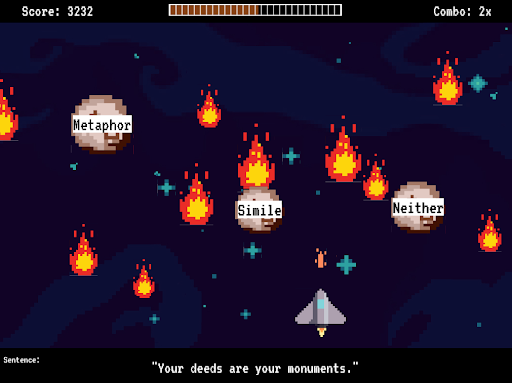
For example, a number of our English courses give students new games each week to practice their grammar. In this Space Blaster game, students shoot down asteroids, and score by hitting the correct ones. They’re free to keep playing for longer combos or a higher score. We want the extrinsic motivation of the asteroid game to be fun enough that students are interested enough to try again.
What Games Teach Us
A student must choose to engage if they are going to learn. Teaching is always a collaboration with the learner, just as game design is a collaboration with the player.
Our dilemma is that we want students to grow in competence and become intrinsically motivated lifelong learners, but often the easiest tool to encourage competence alone is extrinsic motivation: a grade, a prize, the ability to move on to the next level. So, how do we encourage intrinsic motivation?
Our passion for the subject area can be a huge megaphone for intrinsic motivation. This needs to be our go-to. Beyond that, we can learn how to use extrinsic motivation well. How do we create learning experiences where students can fail safely, allowing them to practice with trust and autonomy? How can we provide a level of challenge that allows students to see their own growing abilities? How will we design activities where students practice the skills they actually need?
What can games add to your teaching toolbelt, and how will you ensure that they move students towards becoming lifelong learners?
About the Author

Samuel Karvonen
Assistant Director
Samuel has 15 years video animation experience and 6 years of management experience. He is currently the Assistant Director for StudyForge and has a passion for connecting skilled people to valuable work as the foundation for excellence.